If you live anywhere between Eindhoven and the Belgian border in the next two weeks, look up. You are about to see — and hear — one of the most interesting fortnights in the Dutch aviation calendar.
From 7 to 18 September, Eindhoven Air Base hosts Exercise Falcon Leap 2026, an international training exercise in which transport aircraft from eleven nations practise dropping cargo loads and parachutists over the Netherlands and Belgium. And on Saturday 19 September, the exercise concludes the way it always does: over the Ginkelse Heide near Ede, where participating aircraft join the annual commemoration of Operation Market Garden — dropping parachutists over the same stretch of heather where some two thousand British paratroopers landed in September 1944.
For aircraft enthusiasts, it is the richest concentration of military transport aviation the Netherlands sees all year. For everyone else, it is a story about why these particular aircraft, from these particular countries, fly over this particular ground.
The fleet: a who’s who of European airlift
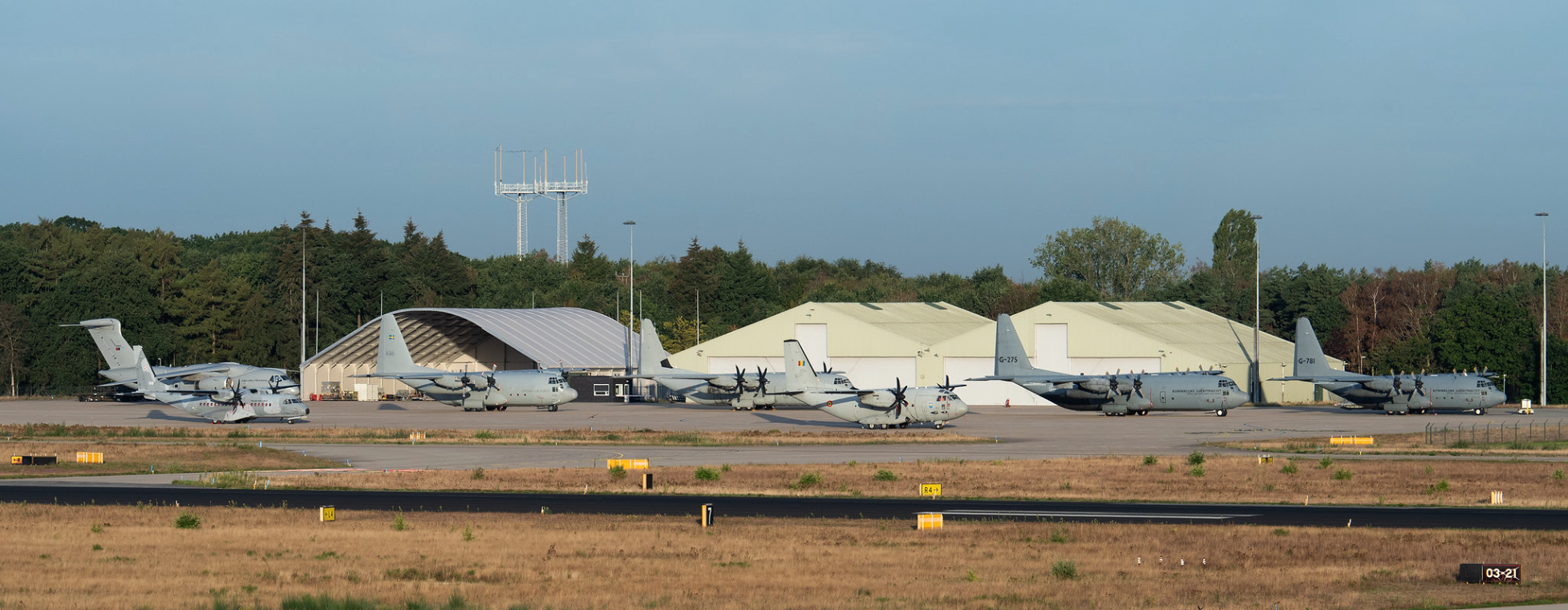
Falcon Leap 2026 brings together a remarkable cross-section of the transport aircraft flying in and around Europe today:
- Airbus A400M Atlas — Germany and the United Kingdom
- Lockheed C-130 Hercules — the Netherlands, the United States, Greece, Italy and, for the first time, Sweden
- Airbus C-295M — Poland and Spain
- Leonardo C-27J Spartan — Romania
- Embraer KC-390 Millennium — Portugal
Two entries on that list deserve a second look.
The first is Sweden, participating in Falcon Leap for the first time — a small but telling detail of how quickly Europe’s newest NATO member has folded itself into allied training.
The second is Portugal’s KC-390. For Dutch observers, this aircraft is more than a visitor: it is a preview. The Royal Netherlands Air Force has selected the Embraer C-390 to succeed its veteran C-130 Hercules fleet, which means the aircraft type lifting off from Eindhoven under Portuguese colours this September is the same one that will wear Dutch roundels in the years ahead. Watching a KC-390 and a Dutch C-130 share a ramp is, quite literally, watching one era of Dutch airlift hand over to the next.
What the exercise actually involves
Organised by 11 Air Mobile Brigade of the Royal Netherlands Army, with air transport coordinated by the Royal Netherlands Air Force’s Air Mobility Command and its international partners, Falcon Leap trains one of the most demanding disciplines in military aviation: putting people and cargo out of an aircraft precisely, safely and together with allies.
Crews practise dropping loads and parachutists over designated zones — the Ginkelse Heide near Ede, the Hechtelse Heide across the border in Belgium, and the Marnewaard in Groningen — while Twente Airport hosts air-landing operations, in which aircraft touch down to deliver troops directly. Flying takes place daily between 08.30 and 23.59, and the aircraft deliberately fly lower than normal traffic, which is why so much of the country will see and hear them. Between the drop zones, the fleet transits through designated low-flying corridors — so even far from Eindhoven, a dark-green silhouette at unusual altitude in the coming fortnight is very likely part of the exercise.
Precision airdrop is not an abstract military skill. It is the same capability that delivers humanitarian aid where no runway exists — Dutch and allied crews put it to use dropping relief supplies over Gaza — and exercises like Falcon Leap are how that capability stays sharp, and stays interoperable between eleven different air forces flying five different aircraft types.
Eindhoven: the busiest fortnight at an already busy base
Eindhoven Air Base is a fascinating piece of aviation infrastructure in its own right: home to the Netherlands’ entire fixed-wing transport capability and a hub for European military air mobility, it shares its runway with Eindhoven Airport — the country’s second-busiest passenger airport. For two weeks, holiday charters and low-cost departures will be sequenced between multinational formations of tactical transports, a coordination exercise all of its own and a reminder of how much operational complexity Dutch aviation absorbs without most passengers ever noticing.
And there is a quiet historical symmetry in the choice of base. Eindhoven was liberated on 18 September 1944 by the American 101st Airborne Division — paratroopers, dropped from transport aircraft, during Operation Market Garden. Eighty-two years later almost to the day, transport aircraft from eleven allied nations will lift off from Eindhoven to train the same craft.
The final jump: 19 September, Ginkelse Heide
That symmetry becomes the whole point on the exercise’s final Saturday.
Operation Market Garden, launched on 17 September 1944, was the largest airborne operation ever mounted — a bold Allied attempt to seize a corridor of bridges through the Netherlands and end the war by Christmas. On 18 September, the second day of the operation, around two thousand British paratroopers of the 4th Parachute Brigade dropped onto the Ginkelse Heide near Ede, on their way to a bridge at Arnhem that would become famous as “a bridge too far”.
Every September, the heath remembers. At the annual Airborne Landings and Commemoration on 19 September 2026, hundreds of parachutists from eleven NATO nations — many delivered by the very aircraft flying Falcon Leap — will descend onto the Ginkelse Heide in mass drops in the morning and afternoon, watched by tens of thousands of visitors, veterans and invited guests. It is one of the most moving sights in European aviation: modern military hardware in the service of memory.
How to follow it
The flying programme changes daily with weather and operations; Eindhoven Air Base posts current flying times on its X account, @VlbEindhoven. Expect the most intensive activity in the exercise’s second week, and note that Defensie does not publish exact drop times and locations in advance, for the safety of jumpers and spectators alike. The commemoration on the Ginkelse Heide on 19 September runs from 09.00 to 16.00 and is open to the public — arrive by bicycle or public transport if you can.
As an Amsterdam-based charter company, we spend our working lives in Dutch airspace — and we will be watching September’s skies with the same fascination as everyone else. We’ll share what we see, here on the blog and on LinkedIn.
Get in touch with any questions about your air charter needs