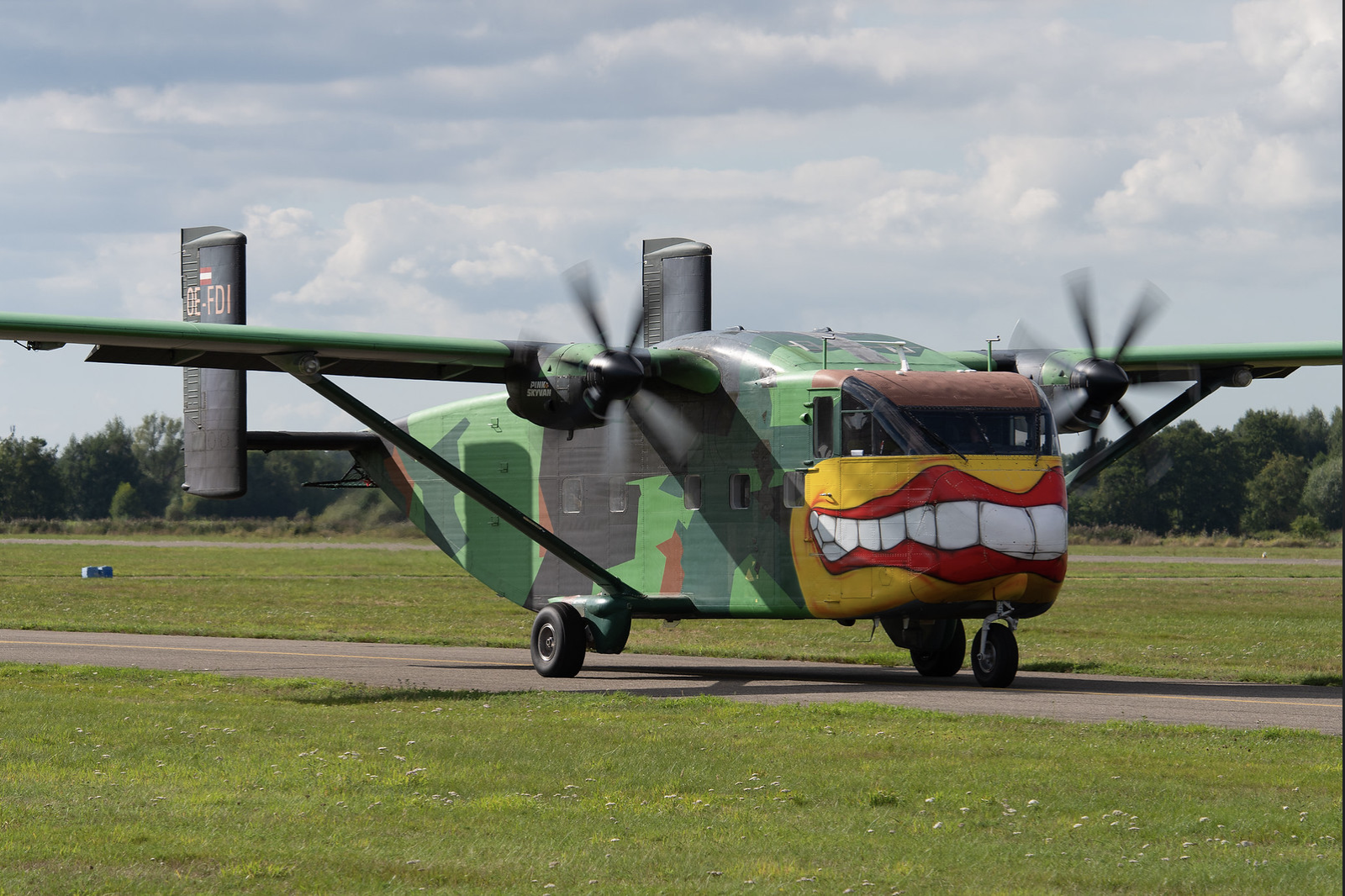
Some aircraft are beautiful. The Short Skyvan is not one of them, and that is precisely the point.
Nicknamed the Flying Shoebox for its unapologetically rectangular fuselage, the Skyvan was never designed to win admirers on the ramp. It was designed to carry awkward loads into short, rough airstrips and out again, with minimum fuss and maximum access. More than sixty years after its first flight, it is still doing exactly that.
At Fliteline, we recently spent time on location in the Netherlands alongside one of these remarkable aircraft, operated by our long-time partners at Pink Aviation Services. It seemed the right moment to give the Skyvan the spotlight it rarely asks for but thoroughly deserves.
Born in Belfast
The Skyvan story begins in the late 1950s at Short Brothers in Belfast, one of the world’s oldest aircraft manufacturers. Shorts had been evaluating a high-aspect-ratio wing transport concept and ultimately decided to pursue its own design instead: an all-metal utility aircraft that put practicality above everything else.
The result first flew on 17 January 1963. Crews quickly nicknamed it “the shed”, but the unconventional shape was doing serious work.
The square-section fuselage created a large, completely unobstructed cargo hold. The high-mounted, braced wing kept the cabin clear and gave excellent low-speed lift. The twin tail fins existed for one very specific reason: to keep the rear of the aircraft free for its defining feature, a full-width rear loading ramp.
Early aircraft flew with Astazou turboprops before the definitive Skyvan 3 switched to Garrett TPE331 engines of around 715 shaft horsepower each, improving performance in hot and high conditions. Just over 150 Skyvans were built before production ended in the mid-1980s. The design lived on, however, evolving into the stretched Short 330 and 360 commuter airliners and the ramp-equipped C-23 Sherpa freighter.
A career built on doing the difficult jobs
Throughout its working life, the Skyvan has gravitated towards the jobs conventional aircraft cannot do. Its short take-off and landing (STOL) performance and rugged fixed undercarriage allowed it to operate from grass, gravel and improvised strips across Africa, Asia and South America.
Operators used it for regional passenger services, outsized freight, aerial survey and mapping, air ambulance work and humanitarian logistics. One even carried an antenna destined for an Apollo mission. That versatility is a familiar theme for us. Much of Fliteline’s special mission work depends on matching unusual requirements to aircraft with exactly the right, and often unusual, capabilities. The Skyvan is a textbook example of an aircraft whose value lies not in speed or glamour, but in being the only sensible answer to a specific question.
The question it answers best: skydiving
Ask any experienced skydiver in Europe to name their favourite jump aircraft and there is a strong chance the answer is the Skyvan. The reasons are built into the airframe.
The rear ramp, roughly two metres square when open, allows large groups of jumpers to exit almost simultaneously. That makes it uniquely suited to big formation jumps that are simply impossible from a side door.
The cabin accommodates up to around 19 jumpers with room to organise. The aircraft climbs efficiently to drop altitudes above 4,000 metres, and its stable, predictable handling at low speed keeps the run-in to the drop calm and controlled.
Only a small number of Skyvans remain airworthy worldwide, which has given the type genuine cult status. Skydivers follow the aircraft from event to event across Europe: a travelling community built around a flying box from Belfast. There is, after all, very little chance of confusing a Skyvan with anything else.
The shape is deceptive in one more way. For all its boxy appearance, the Skyvan is surprisingly manoeuvrable in the air, and Pink Aviation has flown its aircraft in close formation for years, producing some spectacular air-to-air photography.
It is this capability that Fliteline puts to work for clients. Parachute operations sit within our special mission charter services, alongside medical evacuation, survey flights and other specialist tasks. The Skyvan, flown by Pink Aviation Services, is our aircraft of choice when a professional para-drop platform is required.
Why a broker cares about a sixty-year-old aircraft It is a fair question. Fliteline arranges everything from private and group charters to heavy cargo movements. Why does an ageing twin turboprop matter?
Because charter is a matching problem. The right aircraft is the one that fits the mission, and for some missions the market offers exactly one right answer.
Knowing where those rare aircraft are, who operates them to the highest standard, and how to bring them together with a client’s requirement is precisely the expertise that thirty years of charter broking builds.
The Skyvan also holds a broader lesson about aviation: purpose-built beats general-purpose. The aircraft survives not despite its odd looks but because of what those looks enable. No modern type has replicated its combination of rear-ramp access, STOL performance and operating economy, so the Skyvan flies on.
See it for yourself
We will be sharing more from our time alongside the Skyvan. That includes the story of our partnership with Pink Aviation Services, whose care for these aircraft has kept them at the top of the European skydiving scene for decades, and a closer look at the engineering that keeps the type evolving, right down to the distinctive seven-blade propellers Pink developed for their fleet.
If your organisation has a requirement that standard charter cannot solve, whether parachute operations, unusual cargo, remote strips or something nobody has asked us for yet, talk to the Fliteline team. Finding the right aircraft for difficult jobs is what we do.
Get in touch with any questions about your air charter needs